

Moving Beyond 12 Hour Shifts: How Evidence is Powering Change
- Feb 4
- 3 min read

BLOG
Dr Chiara Dall’Ora and Dr Zoé Ejebu, were proud to see their work at the heart of Essex Partnership University NHS Foundation Trust (EPUT)’s Improvement Collaborative in January 2026, on a day that brought community teams together to examine how shift patterns shape staff experience, care quality, and patient safety. It was led by Hayley Mounsey, Deputy Director Community Physical and Mental Health Services.
The event convened 25 managers, team leaders and staff from a variety of community services to redesign shift patterns, with a view of moving away from 12-hour shifts. A central feature was the presentation by Dr Chiara Dall’Ora and Dr Zoé Ejebu. They synthesised national (funded by NIHR ARC Wessex) and international evidence on 12‑hour shifts, highlighting links between long hours and increased fatigue, burnout, sickness absence, reduced continuity of care, diminished care quality, and higher rates of patient incidents, while noting that commonly anticipated benefits (fewer handovers, better continuity, cost savings, and improved work‑life balance) are not consistently supported by the evidence.
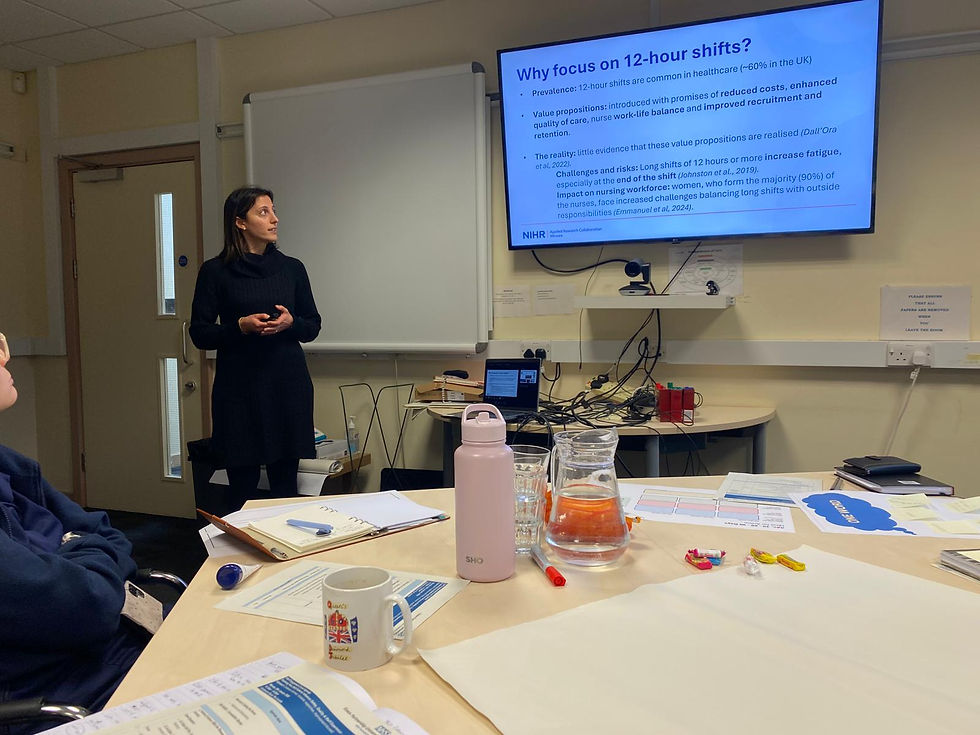
Why this matters
Shifts are not just schedules; they are the scaffolding for safe care and humane work. When shift patterns amplify fatigue or fragment communication, they undermine staff wellbeing and the reliability of services. The workshop gave staff space to reflect on what helps and what hinders, and to turn those insights into actionable principles and practical ideas for change.
From apprehension to confidence
One of the most powerful outcomes was an emotional and engagement shift. At the start of the workshop “one-word” reflections mirrored feelings of concern and uncertainty about the impact of moving away from 12-hour shifts. In final “one‑word” reflections, staff moved from apprehension to feeling empowered, informed, reassured, engaged, interested, and reflective. This change signals growing trust in a collaborative, evidence‑based approach and readiness to co‑design future models of work.
What participants said
“The research led by Dr Chiara Dall’Ora and colleagues has directly shaped how we work in West Essex. Following a review and consultation with staff, we have moved away from 12.5hr shifts and introduced rotation of shorter more frequent shift design to support improved quality oversight and delivery of patient care. The national evidence base has been pivotal in shaping new ways of working - informed by the research and genuine co‑design, we are already seeing stronger staff engagement, richer conversations, and renewed energy for improvement. Staff have told us they found the recent collaborative session on 26th January inspiring, and we’re seeing this spark meaningful ongoing dialogue across our teams. Our emerging local insights strongly align with the national findings, and the partnership with the University of Southampton has enabled meaningful, real‑world conversations with our staff. Following the event we observed a notable shift in sentiment: discussions were evidence‑informed, inclusive, and improvement‑focused. Many colleagues described the session as “inspiring” and expressed how much they valued being involved. This momentum is already encouraging further constructive dialogue within teams as the new shift model embeds.”

How the research is impacting change
The evidence presented by Drs Dall’Ora and Ejebu is informing a move away from default 12‑hour shifts toward patterns that balance staff wellbeing, service reliability, and patient safety. ARC are currently funding a service evaluation in four pilot wards at EPUT to understand the effects of this change in real‑world conditions.
By combining frontline insights with rigorous measurement, we aim to generate clear, actionable evidence that helps EPUT and other providers design shifts that are safer, fairer, and more sustainable.
Next steps
The organisation committed to doing this work with staff, not to staff. Immediate actions include sharing outputs and evidence, convening focus groups for feedback and co‑design, safely testing ideas with mock rotas, and continuing evaluation and learning as changes are introduced.
We fund research to make a practical difference. At EPUT, that difference is already visible: in the confidence and clarity staff expressed, in the principles they co‑created, and in the practical steps now underway. We will continue to support the evaluation, share learning transparently, and help translate findings into better rosters, better teams, and better care.
Thank you to the EPUT colleagues who contributed with candour and creativity, and to the research team for the sustained, high‑quality research that is shaping a safer future for staff and patients alike.


